The journal
Building in Public
The real story of building Avenue3 — the wins, the stumbles, the lessons, and everything in between. No spin. Just honest progress.
Why I built Avenue3 (and what took so long)
For the longest time, I really, badly wanted to build a dating app. My motivation was two things: money, and a long history of being disappointed in dating apps.
The money motivation was pretty straightforward. If the big dating apps are worth billions, one wonders what an app that actually gets people offline and into real relationships might be worth. The disappointment motivation, I think, is pretty self-explanatory. I have friends who met their wives on dating apps — genuinely — but I'm also keenly aware of how much discontent exists around them. There's no shortage of articles on the subject.
I worked on two versions of a dating app before Avenue3 existed. The first spawned three separate apps from one original idea: "Get Offline," "Get Offline: Friendship," and "Get Offline: Dating." This was before AI-assisted development was really a thing, and I didn't have the technical chops to finish them on my own. The second was called "One Hour Only." The original concept was simple — take the 3.1-mile loop around Town Lake for a date, about an hour's walk. After some constructive feedback, I expanded it to include many different venues. I spent basically all of fall and winter of 2025 building it with ChatGPT, and I created something I genuinely thought was worthwhile.
Apple rejected it three times. On the third rejection I appealed, and they came back with a final decision. Their reasoning: "Design Spam." Apparently they have too many dating apps and don't want any more. It really sucked. I had worked hard on it, and that door closed pretty firmly.
There was also an earlier idea, dating back to mid-2020, called "Friends First." The concept was an app geared toward romantic relationships, but starting from friendship — not unlike how most good relationships actually develop. I'm fairly sure "Friends First" eventually morphed into "Get Offline," though honestly the details are a little fuzzy at this point.
Avenue3 didn't arrive with a eureka moment. It was more of a slow recognition — in my own life and in the lives of people around me — that a lot of us are quietly starving for platonic connection. Not romantic connection. Just friends. People to call on a Friday. People who might actually say yes.
Austin has a lot going for it, but it has too much screen time and not enough no-pressure socialization. I think people genuinely want to slow down and be present with each other. They just need a better way to find each other first. That's what I'm trying to build.
Building an iOS app when you're not really a developer
When I built my iOS and Android apps years ago, before "vibe coding" was a thing, I did what is sometimes called "Frankenstein programming." Gathering bits and pieces of working code from Stack Overflow (a mostly reliable code problem-solving website), and then editing them, without higher level knowledge or understanding, until they ran. Although that may sound simple enough, bear in mind that there were plenty of hurdles. Hurdles like having 10–15 build errors. And for each error, instead of button mashing a "Fix" button like you do with the AI, you had to go back to the Internet well, and Google your way to the solution for each build error. And Lord help you if your build errors were entangled with one another.
To me, the difference between coding by yourself, and coding with the AI, is like the difference between trying to run somewhere on foot, or drive a well-machined, smooth-running car there. When you're running somewhere on foot, your whole being is dedicated to getting there. When you're driving the car, you're freed up to talk on the phone, eat or drink, or even be an Uber driver, getting paid to get other people to their destination.
I think right now, as I'm typing this, is a perfect example: I'm working to get the push notifications working for Avenue3. Part of that process is deploying functions to Firebase (Google's backend/mobile solution). The catch is that I have to do it in a programming language called TypeScript. I don't really know the first thing about TypeScript — all I know is that for me it is taking a long time to build and deploy (we're talking at least 10 to 15 minutes per command). And I've had to try about 5–7 iterations at this point, because it keeps erroring out instead of successfully deploying. Be that as it may, my point is this: Claude has written all of the code I needed to make this work. Now, I'm sitting here typing these words, while my Terminal works on trying to deploy the functions, yet again. If I would have done this without the AI, I'd still be stuck reading some documentation.
I really like building software while I'm learning on the go. It's kind of like reading a really great fiction novel: it's always exciting, it builds on itself, and you're always pleasantly surprised in the end. Things aren't always peachy keen though. There are times when it feels like you're building a house built on wobbly stilts, that will get blown away in a stiff breeze.
There is a proverb: "Everything is hard before it is easy." Building an iOS app when you're not really a developer is no exception to this rule.
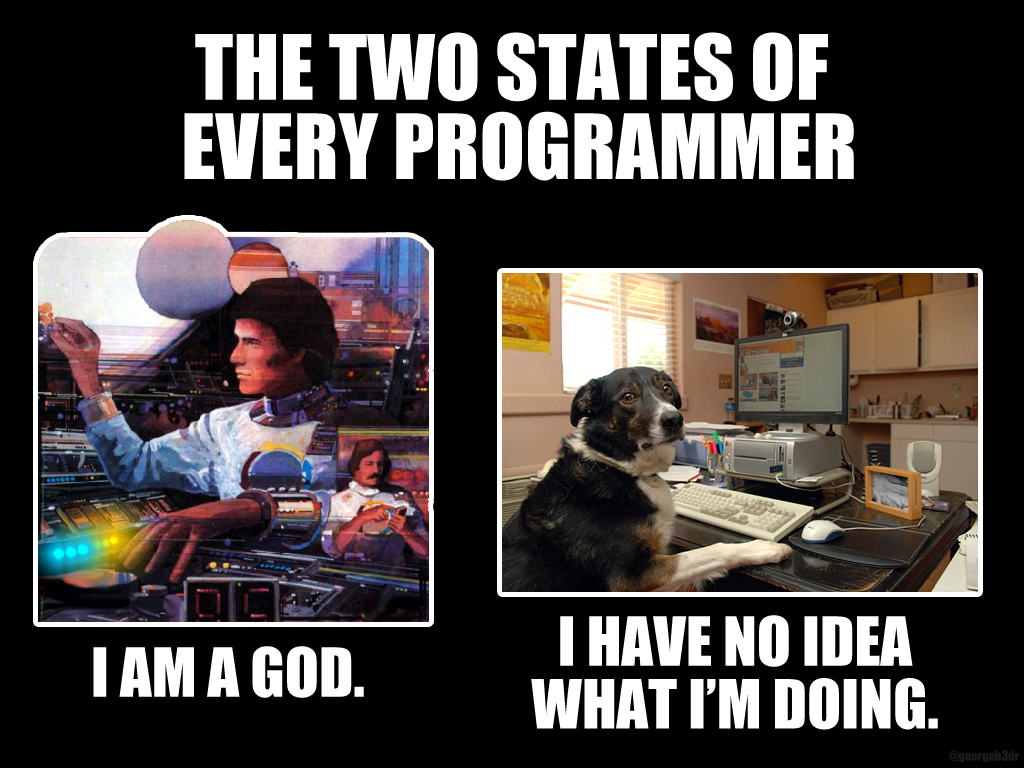
These two states of every programmer can be considered the Yin and Yang, of sorts, of the software development world. You cannot have one without the other, and everything in between consists of some combination of both.
More to come
What matters most, how did we get so busy, and is there a one-size-fits-all solution?
Time is money, and money is time, but does connection trump both?
Carry on
"Continuous effort — not strength or intelligence — is key to unlocking our potential."
Uncle Iroh meme
And how it can be applied to Austin, TX.